Why Dosing Architecture Controls Both Line Speed and Margin
Individual candy pieces weigh 1.5 g to 12 g each, meaning a simple volumetric cup or single-bucket scale routinely gives away one or two extra pieces per bag just to stay above minimum net-weight law. Combinatorial multihead weighers solve that math by reading 10 to 32 radial load-cell hoppers simultaneously (1,023 combinations per cycle on a 10-head unit) and dumping the exact subset closest to target weight.
Compare application tooling in candy application setups and calculate payback in candy machine selection and sizing.
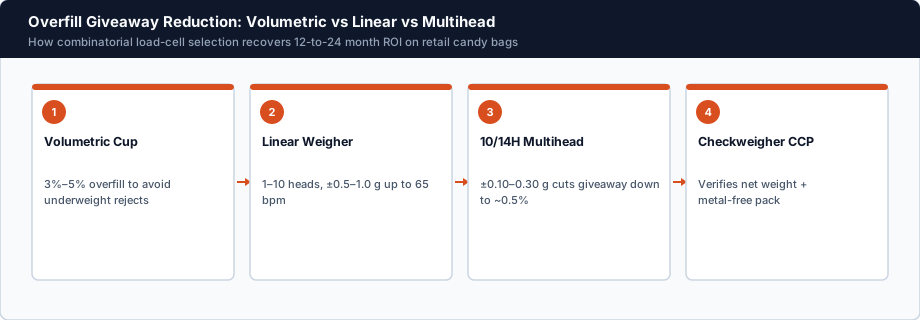
Confectionery Dosing Technology Comparison
Match dosing technology to piece weight uniformity, surface tackiness, and regulatory label claims:
| Dosing System | Head / Lane Count | Published Speed | Typical Accuracy | Best Confectionery Fit |
|---|---|---|---|---|
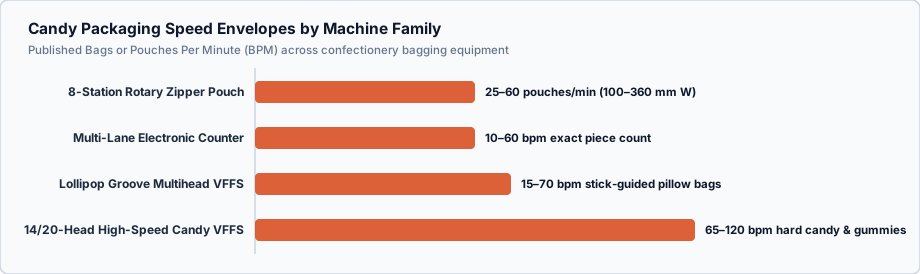
| Linear Vibratory Weigher | 1–10 linear heads | 15–65 bags/min | ±0.5–1.0 g | Free-flowing uniform sugar, dragees, wrapped drops |
| Multihead Combination Weigher | 10, 14, 20, or 24 radial heads | 60–200 weighments/min | ±0.10–0.30 g | Gummies, mixed assortments, hard candy, toffees |
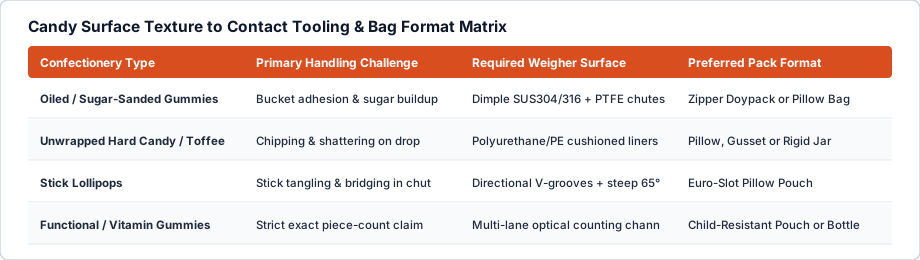
| Stick-Groove Multihead Weigher | 10–14 V-grooved heads + steep cone | 15–70 bags/min | ±0.2–0.5 g (1 piece) | Ball & flat lollipops with paper/plastic sticks |
| Multi-Lane Optical Counter | 4–16 vibratory optical channels | 10–60 packs/min | 99.9%+ exact count | Nutraceutical gummies, throat lozenges, mints |
See complete bagging frames in candy packaging machines.
Confectionery Engineering Details
- High-Frequency Vibratory Pan Control: Sticky pectin and gelatin gummies require higher-amplitude linear electromagnetic feeders and steep 60°–65° discharge chutes to keep single-piece trickle feeds moving.
- IP65/IP68 Washdown Electronics: Confectionery sanitation uses warm water to dissolve sugar films; sealed load-cell housings let crews wash buckets and pans without drifting zero calibration.
- Multi-Mix Radial Partitioning: 16- and 24-head weighers can split radially into 2–4 zones to blend exact ratios of fruit flavors or candy assortments in a single drop.
Validating Piece Weight vs Target Bag Weight
Send average single-piece weight (g), min/max piece dimensions, and coating recipe so hopper volume (0.5 L, 1.6 L, or 2.5 L) is matched cleanly.
Submit your dosing specs on our Project Brief.
Compare related confectionery systems in Candy Packaging Machines, Weighing & Dosing Specs, or send your candy specs via Project Brief.